
The opportunity
Telemedicine brands do not fail because the clinical idea is weak. They fail because the stack underneath is a 12-month integration roadmap: intake forms that do not talk to consult workflows, provider networks bolted on with brittle webhooks, pharmacy fulfillment as a separate SFTP theater, and compliance treated as a spreadsheet afterthought.
Rolling your own means years of FHIR modeling, adapter work, audit trails, and pharmacy negotiation before the first patient completes intake. Buying a closed platform often means per-patient fees, limited white-label control, and an architecture you cannot self-host or extend. Neither path matches how modern digital health actually needs to ship.
That is a systems problem. We built RX Library as the answer: a proprietary, clinical-grade telemedicine platform, the Shopify of telemedicine, developed in partnership with MD Integrations (MDI) to make telemedicine development accessible without sacrificing HIPAA, enterprise readiness, or engineering honesty.
Before
- 12-month integration roadmap per brand
- Brittle webhooks and fragmented EMR work
- Pharmacy fulfillment as separate SFTP theater
- Compliance as spreadsheet afterthought
After
- Weeks to first patient on a shared clinical spine
- FHIR R4 Task state machine with audit logging
- Adapter-first provider and pharmacy networks
- White-label, multi-tenant, SOC 2 ready
The spine: FHIR-native order orchestration
The core is not a marketing site with a form. It is a FHIR R4 clinical data engine with a Task state machine that owns the full order lifecycle.
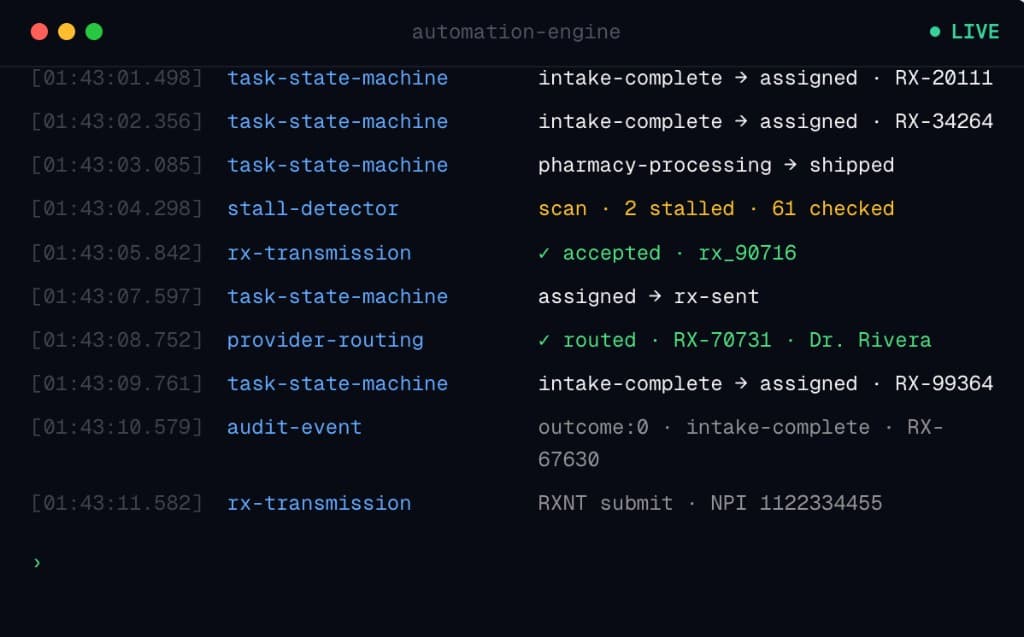
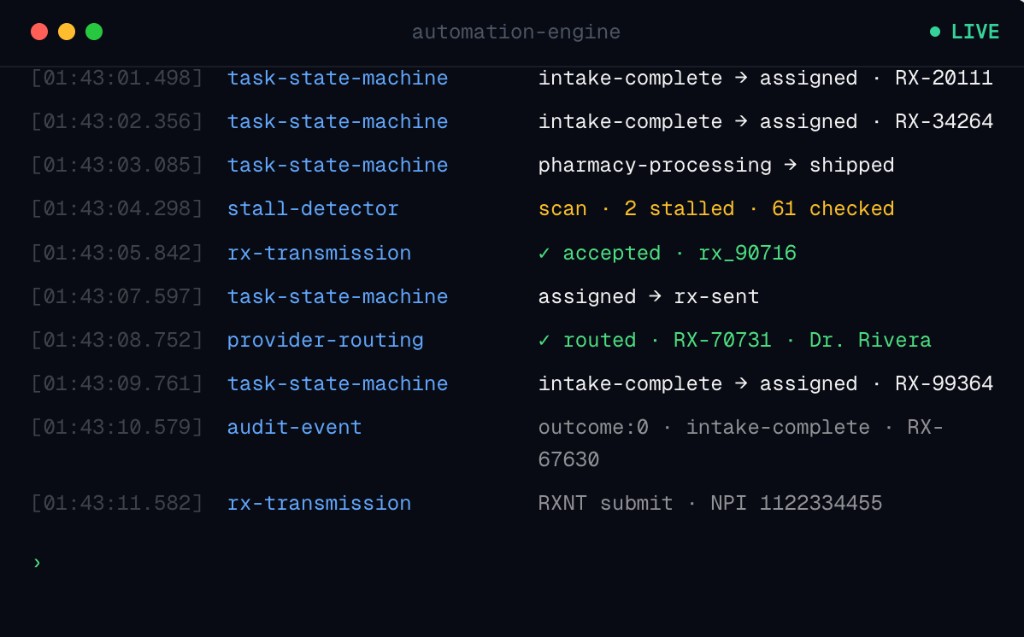
Every patient order moves through a fixed clinical path: Intake → Assigned → Consult → Rx Sent → Shipped → Fulfilled. Steps cannot be skipped. Every state change is immutably logged as an AuditEvent. Refills schedule from the same machine instead of living in someone's inbox.
That spine is what makes the rest possible. Provider routing, pharmacy transmission, catalog pricing, and brand configuration all attach to one clinical record of truth. Without it, every integration becomes a one-off reconciliation problem. With it, the platform can guarantee prescriptions do not drop and compliance does not depend on tribal knowledge.
Adapter-first integrations, live when the key lands
Integrations are where telehealth builds usually die.
RX Library ships adapter-first. Provider networks, pharmacies, e-prescribing, payments, and catalog sync are mocked with MSW fixtures by default. Drop in a real API key and the adapter flips to live, with zero core code changes. Idempotent automations search-before-create so replays are safe. Nine automation workflows cover the intake-to-fulfilled path without manual babysitting.
Pre-wired partners include provider networks (MDI, OpenLoop, Beluga), e-prescribing (RXNT), pharmacies (GoGoMeds, Partell), payments (Stripe), and storefront sync (WooCommerce), plus catalog sync where brands already keep product truth. The heavy lifting of compliance, legal, and API normalization sits in the platform so each brand team is not renegotiating the same stack from scratch.
White-label, multi-tenant, enterprise-ready
Digital health brands need their domain, their visual system, and their catalog, not a shared chrome they cannot escape.
The platform is 100% white-label and multi-tenant: dozens of distinct brands can run on one instance with patient data, provider routing, and product catalogs fully siloed. Self-hosted or managed. SOC 2 ready. HIPAA compliant. $0 per-patient fee, with no usage tax on growth.
The medication catalog ships pre-loaded: 400+ medications across treatment categories, ready to price and route. Routes, roles, and admin pipeline surfaces ship as product, not as a custom build ticket. The first brand on the platform is already live in production as a weight-loss telehealth operation: real patients, real prescriptions, every component a new brand would inherit.
We went from idea to first patient intake in three weeks. That would have been years if we'd built this ourselves.
What it produced
Time to first patient compresses from a multi-year DIY roadmap into weeks. One operator quote from the platform launch arc: idea to first patient intake in three weeks.
The engineering surface that makes that claim real: FHIR R4 clinical engine, nine automation workflows, three provider networks, multiple pharmacy partners, white-label multi-tenancy, and a catalog that does not require sourcing before day one. The live product surface includes the admin pipeline, order state, and the clinical console brands inherit on day one.
Worth being precise. This is a platform build, not a single-client growth campaign. The metrics above are product capabilities and launch-path outcomes of shipping the operating system itself with MDI. What matters is the machine: clinical state guaranteed, adapters swappable, brands launchable without reinventing telemedicine infrastructure every time.